


Lesson Plan
Community Action Programs: The Most Controversial Aspect of the War on Poverty
Location
Years
Cleveland, Ohio
1960s/1970s
Theme
Classroom
Poverty Policy
Distribution of Public Resources
College, High School
About this Module
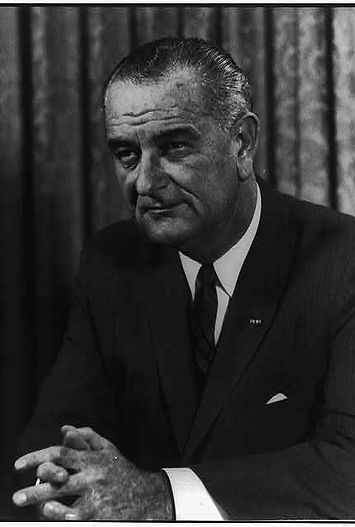
Lyndon B. Johnson, head-and-shoulders portrait, facing left, June, 964. Photographer: Unknown. Photo archived at the Library of Congress.
In this lesson, students will learn about how Community Action Programs became the most controversial aspect of the War on Poverty by examining competing interpretations of the Economic Opportunity Act of 1964, especially the "maximum feasible participation" clause. Students will evaluate the power struggles between federal and state lawmakers and residents of impoverished neighborhoods while analyzing a variety of primary sources. Students will gain a better understanding of how local context contributed to the success or failure of War on Poverty programs.
The setting is Northern U.S. cities, with a heavy emphasis on Cleveland, Ohio. The three sources include criticisms of the local War on Poverty board, the Council for Economic Opportunity, that offer a compelling snapshot of how leaders from civil rights organizations, labor unions, religious institutions, and impoverished
communities understood "maximum feasible participation." Grassroots coalitions, such as the Citizens Committee for an Adequate Cleveland Community Action Program in Primary Source #1, used the Economic Opportunity Act's language to demand that individuals with firsthand experience with poverty have significant influence over antipoverty policymaking. This lesson shows how the War on Poverty opened an opportunity to incorporate economically disadvantaged citizens into the planning, administration, and oversight of welfare. It also reveals the limited but vital support federal officeholders provided to grassroots organizations.
Primary Source #1 - Critique of the Cleveland Community Action Program
Critique of the Cleveland Community Action Program Proposal, October 1, 1964, box 2, folder 33, MS 4474, Inner City Protest Parish Records, Western Reserve Historical Society, Cleveland, Ohio.


Primary Source #2 - Demands of the Citizens Committee for an Adeqaute Cleveland Community Action Program
Critique of the Cleveland Community Action Program Proposal, October 1, 1964, box 2, folder 33, MS 4474, Inner City Protest Parish Records, Western Reserve Historical Society, Cleveland, Ohio.

Primary Source #3 - Letter from US Representative Charles A. Vanik to Director Sargent Shriver
Letter from US Representative Charles A. Vanik to Director Sargent Shriver, October 1, 1964, box 2, folder 35, MS 4474, Inner City Protest Parish Records, Western Reserve Historical Society, Cleveland, Ohio.


Core Question: How did different political actors understand the phrase "maximum feasible participation?"
Context
After President Lyndon B. Johnson announced his plans for "an unconditional war on poverty," he signed the Economic Opportunity Act of 1964 into law. This legislation established the federal Office of Economic Opportunity and allocated $3 billion for antipoverty programs. The agency vetted applications from local governments for Community Action Programs. These federally funded programs were drafted at the local level to allow for flexiblity. But the bill's authors knew that local control was a double-edge sword. While it enabled cities and towns to account for their economic content, it had also allowed Southern governors and mayors to excluding African Americans from welfare under the New Deal. Sargent Shriver inserted a safegaurd against such racism into the Economic Opportunity Act. The legilsation read, “the term community action program means a program…which is developed, conducted, and administered with the maximum feasible participation of residents of the areas and members of the groups served (emphasis added).”
That phrase, "maximum feasible participation," empowered the Office of Economic Opportunity to withhold federal money from areas that discriminated against African Americans. But it also broke with centuries of precedent in which welfare policies were crafted for the poor by opening a new opportunity to plan with the poor. That opportunity, and grassroots activists and organizations' determination to seize upon it, led the Community Action Programs to become controversial.
The three sources in this module detail the debate surrounding the "maximum feasible participation" clause through the perspective of grassroots activists and their allies. The first source criticizes Cleveland Mayor Ralph Locher for using his appointment power to limit the working class and the poor's direct involvement in policymaking, a common trend across U.S. cities during the War on Poverty. The second source outlines demands made by Citizens Committee for an Adequate Cleveland Community Action Program, a grassroots coalition formed to give low-wage workers, welfare recipients, and professionals who worked in impoverished communities significant influence overthe War on Poverty's local administration. The third source demonstrates that powerful allies in the federal government offered their support for such demands. Together, all three illustrate the local power struggles over "maximum feasible participation" and Community Action Programs.
Council for Economic Opportunity Appointees by Race and Gender

Residential and Economic Characteristics of Council for Economic Opportunity Appointees

Teaching
The meaning of "maximum feasible participation" was contested. Here is a list of prompts that students can respond to in group discussions or short writing assignments. These questions can lead students to understand how local context contributed to the War on Poverty's success or failure and transformed Community Action Programs into sites of intense power struggles between community members and elected representatives.
-
For the Critique document, teachers can prompt students to consider why Mayor Ralph Locher appointed predominantly white, suburban, middle-class members to Cleveland's Council for Economic Opportunity. What does this composition suggest about Mayor Locher's interpretation of "maximum feasible participation?"
-
For the Demands document, how did members of the Citizens Committee for an Adequate Cleveland Community Action Program understand "maximum feasible participation?" If met, how would their demands have altered the power dynamics between low-income and middle-class members of the Council for Economic Opportunity?
-
For the Letter document, how did U.S. Representative Charles Vanik intervene in the debate over "maximum feasible participation" occurring in his home district and city? What impact on the local power struggle might his letter have had?
-
Drawing on all three sources, teachers should instruct students to reflect on the intended purpose of "maximum feasible participation" and the struggle to define that phrase in Cleveland. Students can weigh the merits of the Citizens Committee for an Adequate Cleveland Community Action Program's critique and demands. Point out that the Economic Opportunity Act authors included that clause to empower the federal government to prevent discrimination, meaning they sought to limit mayoral power while maintaining local control. Consider how grassroots activists and organizations took this phrase at face-value, seeking to place power over the War on Poverty in the poor's hands. Teachers could center the conversation on the Economic Opportunity Act's break from precedent by highlighting local officials' attempts to minimize direct participation among low-wage workers and welfare recipients. College students and advanced learners may discuss how "maximum feasible participation" was a debate about how to ensure power derived from the people in a democracy.
Further Context and Teaching Resources
Annelise Orleck, Storming Caesars Palace: How Black Mothers Fought Their Own War on Poverty (Beacon Press, 2005).
This book explores the Black mothers in Las Vegas, Nevada, who successfully circumvented obstructive state and local officials to gain control over local Community Action Programs. With help from sympathetic lawyers and other professionals and through direct action protests, they accumulated power and secured grants from the Office of Economic Opportunity. The federal money enabled the founding of Operation Life, a community center that offered medical care, food assistance, tutoring programs, and recreation.
Annelise Orleck, and Lisa Gayle Hazirjian, eds., The War on Poverty: A New Grassroots History, 1964-1980 (University of Georgia Press, 2011), Part One.
Part One has four chapters (written by Guian A. McKee, Rhonda Y. Williams, Wesley G. Phelps, and Marc S. Rodriguez) that examine case studies from various US cities. Annelise Orleck's introduction also provides a great overview of the historiography of the War on Poverty, detailing how a renewed focus on local context has illuminated the power struggles between elected politicians and grassroots activists that determined the effectiveness of antipoverty programs.
Wesley G. Phelps, A People's War on Poverty: Urban Politics and Grassroots Activists in Houston (University of Georgia Press), Chapter One.
Chapter One examines how the federal government intervened in the power struggle between Houston Mayor Louie Welch and grassroots activists over Community Action Programs. Of particular interest are the specifics of how Welch tried to redirect War on Poverty funds to regular municipal expenditures and how Sargent Shriver's office withheld money from the city until he upheld"maximum feasible participation."
Kimberly Stahler, "Rats, Gender, and Representation: How Cleveland Welfare Rights Activists Defined Democracy, 1964-1966,” Journal of Urban History 50, no. 3 (2024): 674-692, https://doi.org/10.1177/00961442221102120.
This article narrates the struggle between Mayor Ralph Locher and the Citizens Committee for an Adequate Cleveland Community Action Program by examining how members of that grassroots coalition understood "maximum feasible participation" as the chance to enact radical forms of democracy.
Other case studies worth referencing:
Michael Woodsworth, Battle for Bed-Study: The Long War on Poverty in New York City (Harvard University Press, 2016).
Thomas J. Ward, and Jack Geiger, Out in the Rural: A Mississippi Health Center and its War on Poverty (Oxford University Press, 2016).
Jessica Wilkerson, To Live Here, You Have to Fight: How Women Led Appalachian Movements for Social Justice (University of Illinois Press, 2019), Chapter 2.