


What is Participatory Democracy?
Democracy is about more than voting.
Participatory democracy is a system of governance in which the people who a policy affects have significant influence over its crafting. The phrase gained popularity during the 1960s thanks to organizations in the New Left. Thinkers published their ideas in Dissent, The New Republic, and more. But activists gave participatory democracy meaning as they waged grassroots battles. They enacted democracy by using every political tool available to citizens.
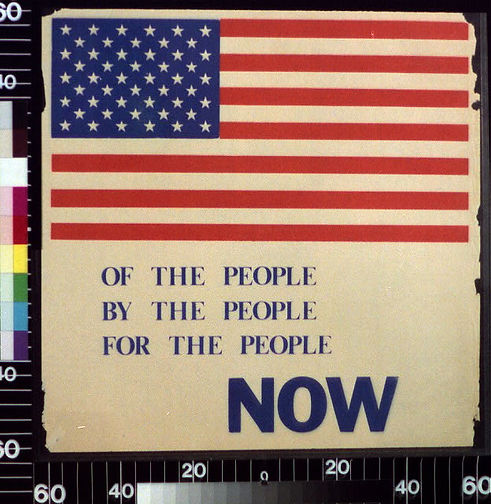
How did women of the welfare rights movement define democracy?
If you could go back in time and ask the women of Cleveland's welfare rights movement what they meant by participatory democracy, they would likely tell you "community control" or "neighborhood control." Most simply, participatory democracy is a system that ensures people have power and influence over the decisions that affect their daily lives. Leaders in Cleveland sought to enact this form of popular sovereignty by launching community oversight of the Welfare Department, speaking out in public forums, holding rallies and marches, and lobbying for legislation at the local, state, and federal levels.
Since time travel is impossible, we have to reconstruct their perception of democracy from the records these women left behind and from oral histories with survivors. Black leader of Citizens United for Adequate Welfare, Carole King, used a story to explain her vision for welfare while testifying before the U.S. Commission on Civil Rights. She described an occasion when members of the organization "had asked the county officials that we all get together with county, State, and Federal officials to sit down and discuss the problems [claimants faced].” Perhaps unsurprisingly, their request was rebuffed. Officials did not take the suggestion seriously. “They thought it was a ridiculous offer,” she recounted. “They would probably be surprised,” King countered. “We probably could work something out that would actually help the mothers and fathers that are on welfare.” From this story, we can see that King and others believed that a democratic welfare state would involve people experiencing poverty in anti-poverty policymaking.
Participatory democracy was more than a system of governance. It was also a way of organizing a social movement. Its principles pushed women on welfare to implement safeguards to ensure that college-educated organizers and middle-class allies did not overpower them in grassroots groups. The Cleveland Welfare Rights Organization's constitution, written in Carole King's living room, welcomed as members "middle income [people]...who have a deep desire to better the conditions of welfare recipients and who will participate and support the rights of recipients." But two provisions placed decision-making power firmly in the hands of members who were on welfare. The first read, "At no time shall middle income or suburban members run or rule the C.W.R.O." The second provided that "if at a regular meeting more middle income or suburban members are present than welfare recipients and [/] or low income people the acting chairman has the authority to give the majority vote to the welfare recipient and low income people present at such a meeting." With these clauses, women on welfare ensured that they maintained power and authority at the grassroots level of the political movement for their rights. Participatory democracy, for them, also involved crafting an organizational structure that prevents allies from overpowering those affected by welfare policies.
Below are quotes from women on welfare and college-educated organizers who supported participatory democracy during the 1960s that help offer a glimpse into their definition of democracy.
Lillian Craig, white single mother in Citizens United for Adequate Welfare
“I think we [welfare recipients] were denied every kind of right that the Constitution says we’re allowed to have.”
Oral history interview, 1978
Margaret George, Black single mother in Citizens United for Adequate Welfare
“This is supposed to be the land of Democracy but I haven’t seen it in 29 years of my live [sic]. Every City official is put in office by people whom they call ignorant, illiterate, uneducated, and immoral women which is that they call those who are on welfare.”
Printed in ERAP Newsletter, August 27, 1965
Greater Cleveland Welfare Rights Organization
"Democracy, a system which guarantees welfare recipients direct participation in the decisions under which they must live."
Exercpt from Purpose of GCWRO.
Carole Close, Organizer with Students for a Democratic Society
"Democracy has a hard time functioning in a capitalistic society. So as long as we're controlled by the corporations, and as long as you have a capitalistic system that is inherently there. You really don't have to democracy. So if you can have that, on a smaller level, in an organization that you belong to, or where you function, I think it has to happen on those kinds of levels. I don't see it. I don't see it. I don't think what we have is democracy"
Interview with author, November 8, 2021.
John Roberts, Organizer with Inner City Protestant Parish
"Democracy is really people not governing themselves, but having a say in how you know, and how their lives are organized and how they run."
Interview with author, January 13, 2023.
Jenny Roper, Organizer with Students for a Democratic Society
"A combination of having some ability to determine for myself, for oneself, what is in my best interests combined with being able to contribute to and ensure that the common good is observed, is contributed to."
Interview with author, January 25, 2023.
Al Haber, Organizer with Students for a Democratic Society
"The people who are affected by decisions, you know, have a voice in making them. So in every decision, the people should have, should be empowered to know what was going on."
Interview with author, February 16, 2022.
Charlotte Phillips, Organizer with Students for a Democratic Society
"People being able to have control over their lives with things that are important and meaningful to them, over aspects of one's life."
Interview with author, March 7, 2021